
In the world of classical computing, everything boils down to a bit—a simple switch that is either 0 or 1. But we are entering the era of the Qubit (Quantum Bit), the fundamental building block of quantum computers. Unlike classical bits, qubits follow the strange and beautiful laws of quantum mechanics.
Here are five key topics you need to know to understand how qubits are changing the future of technology.
1. Superposition: Being in Two Places at Once
The most famous trait of a qubit is superposition. While a classical bit is like a coin lying flat on a table (either heads or tails), a qubit is like a coin spinning on its edge. It exists in a mathematical state of both 0 and 1 simultaneously.
This allows quantum computers to process a massive amount of data at once. If you have two classical bits, they can represent one of four combinations (00, 01, 10, or 11). Two qubits, however, can represent all four combinations at the same time.
2. Entanglement: The “Spooky” Connection
Albert Einstein famously called entanglement “spooky action at a distance.” When two qubits become entangled, they become permanently linked, regardless of how far apart they are.
If you measure one entangled qubit and find it is in state “0,” its partner will instantaneously reflect a corresponding state, even if it’s on the other side of the universe. This synchronization allows qubits to work together in a highly coordinated fashion, leading to exponential increases in computing power.
3. Quantum Decoherence: The Fragility of Magic
If qubits are so powerful, why don’t we have quantum laptops yet? The answer is decoherence.
Qubits are incredibly sensitive. The slightest vibration, change in temperature, or electromagnetic wave can cause them to lose their quantum state and “collapse” into a regular 0 or 1. This is why many quantum computers are kept in dilution refrigerators that are colder than outer space. Protecting qubits from the “noise” of the outside world is the biggest engineering challenge of our time.
4. Types of Qubits: How do we build them?
Scientists are still racing to find the “perfect” way to create a qubit. There isn’t just one type; different companies use different physical systems:
| Qubit Type | Description | Main Player |
| Superconducting | Uses tiny loops of superconducting wire at ultra-cold temps. | Google, IBM |
| Trapped Ions | Uses individual atoms held in place by electromagnetic fields. | IonQ, Quantinuum |
| Photonic | Uses particles of light (photons) to carry information. | PsiQuantum |
| Topological | A theoretical qubit that is more stable due to its “shape.” | Microsoft |
5. Quantum Gates: Programming the Unthinkable
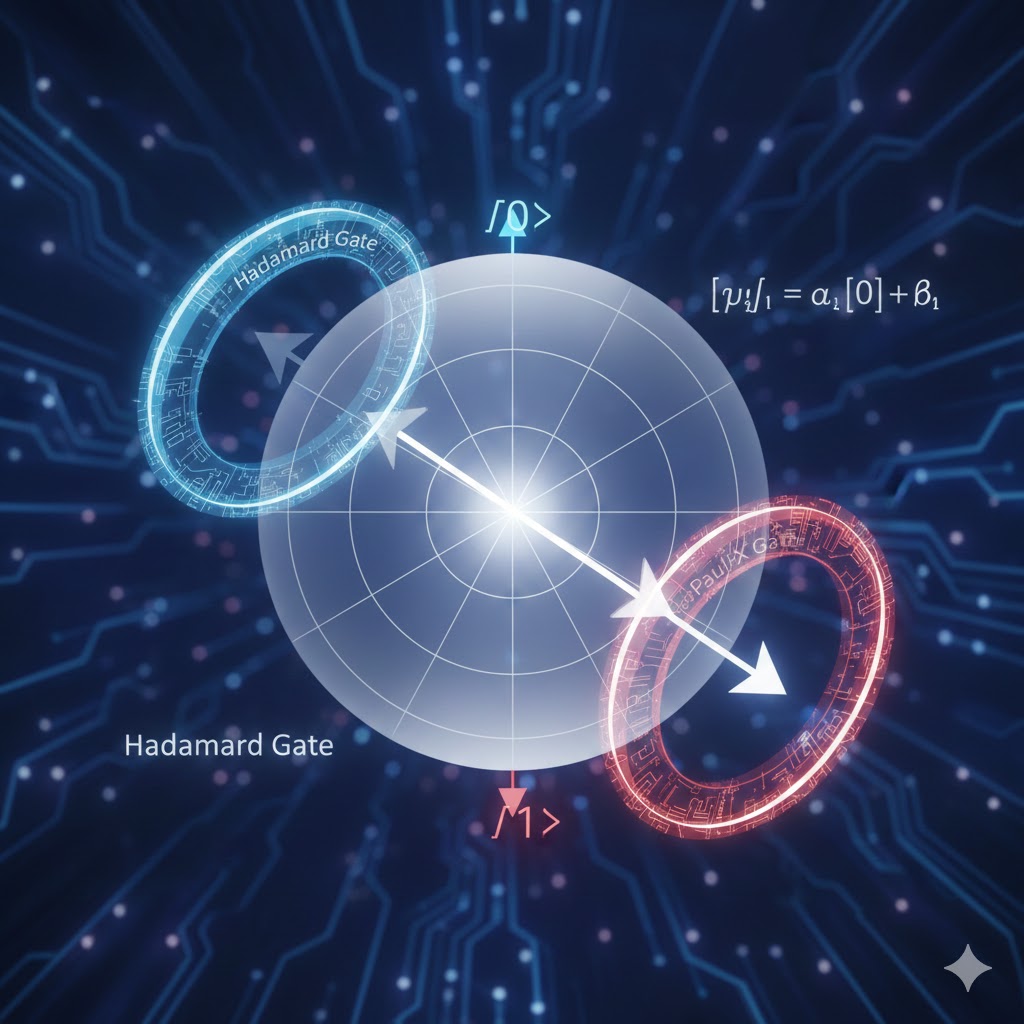
In a normal computer, logic gates (AND, OR, NOT) manipulate bits. In quantum computing, we use Quantum Gates. These gates rotate the state of a qubit on what is called a Bloch Sphere.
Because qubits work with probabilities, quantum programming isn’t about getting a single “right” answer through a linear path; it’s about choreographing interference patterns so that the wrong answers cancel each other out and the right answer “appears” with high probability at the end of the calculation.
Conclusion
We are currently in the “NISQ” era (Noisy Intermediate-Scale Quantum), where qubits are still a bit messy and prone to error. But as we master these five areas, we move closer to solving problems in medicine, climate science, and encryption that are currently impossible for any supercomputer on Earth.